Tuesday, May 7, 2013

Doug Middendorf's Quiz

What do we mean by dark matter and dark energy?
Energy and matter that emits little or no light but interacts with celestial objects.
What is the evidence for dark matter in galaxies?
Weighing spiral galaxies with rotational curves and weighing elliptical galaxies.
What is the evidence for dark matter in clusters of galaxies?
Orbital velocities, x-ray emission and gravitational lensing.
Does dark matter really exist?
Yes, or our current understanding of gravity is wrong.
What might dark matter be made of?
MACHOs and WIMPs.
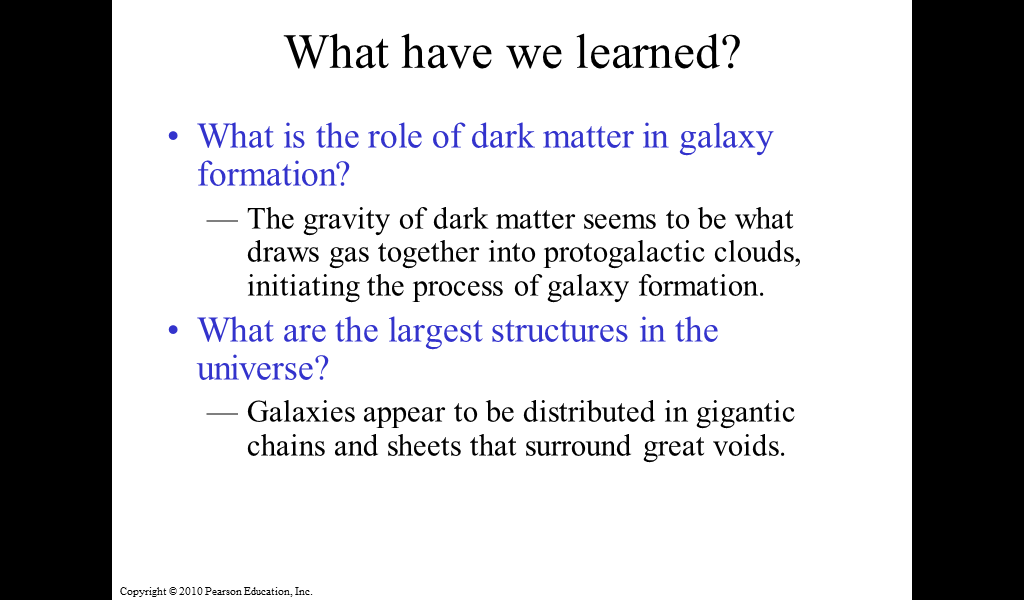
What is the role of dark matter in galaxy formation?
It clumps together and manipulates celestial objects with gravity.
What are the largest structures in the universe?
Large quasar groups
Who was Fritz Zwicky?
Zwicky found that clusters have huge mass to light ratios
Who is Vera Rubin?
measured the rotation curves for various spiral galaxies.
Who is Alex Filippenko?
An American astrophysicist and professor of astronomy at the University of California, Berkeley.

Doug Middendorf's Quiz

How do we observe the life histories of galaxies?
By categorizing them.
How did galaxies form?
Galaxies form from giant clouds of condensing gas and dust.
Why do galaxies differ?
Collisions and the formations affect the way galaxies turn out. 
What are quasars?
Active galactic nucleus.
What is the power source for quasars and other active galactic nuclei?
Black holes.
Do supermassive black holes really exist?
Almost certainly.
What does QUASAR mean?
Quasi-stellar radio source.
Who is Maarten Schmidt?
Maarten Schmidt is a Dutch astronomer who measured the distances of quasars.
What is Cosmology? 
The study of the origins and eventual fate of the universe.
What is the Cosmological Principle? 
The universe looks about the same no matter where you are within it.

Quiz


  1. What do we mean by dark matter and dark energy?
  2. What is the evidence for dark matter in galaxies?
  3. What is the evidence for dark matter in clusters of galaxies?
  4. Does dark matter really exist?
  5. What might dark matter be made of?
  6. What is the role of dark matter in galaxy formation?
  7. What are the largest structures in the universe?
  8. Who was Fritz Zwicky?
  9. Who is Vera Rubin?
  10. Who is Alex Filippenko?
Hint: Check Dark Matter, and Dark Energy in Wikipedia.

5/7/13 Quiz VC


Vinnie Caringella
Astronomy
5-7-13
Quiz

1. Images of the deep universe allow us to study galaxies at many different distances
2. Our models of galaxy formation suggest that protogalactic clouds formed in regions of slightly enhanced density in the early universe.
3. Elliptical galaxies may have formed from protogalactic clouds that were spinning more slowly or were denser than those that formed spiral galaxies.
4. Quasars are extremely luminous and are a very energetic and distant active galactic nucleus.
5. Quasars are probably powered by matter falling into supermassive black holes.
6. Observations of rapidly orbiting material at the centers of galaxies indicate that at least some galaxies, and perhaps all of them, harbor supermassive black holes.
7. A quasi-stellar radio source.
8. Maarten Schmidt is a Dutch astronomer who measured the distances of quasars. 
9. Cosmology is the study of the origins and eventual fate of the universe.
10. The Cosmological Principle is the dynamical structure principle that falls from the working assumption that the distribution of matter in the universe is homogeneous and isotopic when viewed on a large enough scale.

Monday, May 6, 2013

Alexei Filippenko - Wikipedia, the free encyclopedia

Alexei Filippenko - Wikipedia, the free encyclopedia:

 "Alexei Vladimir Filippenko (born July 25, 1958) is an American astrophysicist and professor of astronomy at the University of California, Berkeley. Filippenko graduated from Dos Pueblos High School in Goleta, CA. He received a Bachelor of Arts in physics from the University of California, Santa Barbara in 1979 and a Ph.D. in astronomy from the California Institute of Technology in 1984, where he was a Hertz Foundation Fellow. He was a Miller Fellow at UC Berkeley and was subsequently appointed to a faculty position at the same institution. His research focuses on supernovae and active galaxies at optical, ultraviolet, and near-infrared wavelengths."
'via Blog this'

Chapter 16 Transparency 5


Chapter 16 Transparency 4